
Sports Chiropractic Care and Optimal Human Performance | Sherman College of Chiropractic
Athletes train to improve strength, speed, coordination, endurance, and recovery. Their performance is supported by a team that may include physicians, athletic trainers, physical therapists, coaches, strength professionals, and recovery specialists.
Each professional brings a defined area of expertise. Many also share access to therapeutic tools used for mobility, rehabilitation, conditioning, and return to play.
The chiropractor contributes something distinct.
Doctors of chiropractic are trained to locate and correct vertebral subluxation. In a sports setting, that means evaluating how spinal function may influence movement, coordination, balance, recovery, and overall performance.
Sports chiropractic care is not limited to helping an injured athlete return to competition. It also supports athletes who are already performing at a high level and want to continue improving.
What Is the Chiropractor’s Role in Athletic Performance?
Athletic performance depends on efficient communication between the brain and body.
Every sprint, jump, throw, cut, and landing requires the nervous system to process information and respond quickly. Balance, posture, coordination, reaction time, and movement control all depend on that communication.
Athletes place repeated physical demands on the body through training, travel, competition, contact, and recovery. Chiropractors evaluate the spine and nervous system for vertebral subluxation and provide an adjustment when indicated.
That role gives chiropractors a unique place on the athlete’s care team.
How Is Sports Chiropractic Different From Other Forms of Athlete Care?
Athletes often use a range of services to support performance and recovery. These may include stretching, taping, rehabilitation, strength training, soft tissue work, mobility programs, and recovery technology.
Chiropractors may understand and work alongside many of those approaches, but their primary responsibility is different.
The chiropractor is specifically trained to evaluate the spine for vertebral subluxation and deliver a chiropractic adjustment. That training allows the chiropractor to contribute a nervous-system-centered perspective that complements the work of other sports professionals.
Sports chiropractic is not a replacement for athletic training, physical therapy, medicine, coaching, or strength and conditioning. It is a distinct discipline that adds another level of support for the athlete.
How Does the Nervous System Affect Athletic Performance?
Ligaments, muscles, tendons, and joints contain specialized sensory receptors called proprioceptors. These receptors continuously send information to the central nervous system about joint position, muscle tension, movement, and changes in the body.
That information helps the athlete maintain posture, coordinate movement, and respond to physical demands. Changes in neuromuscular control may affect balance, stability, timing, or movement efficiency.
At higher levels of competition, small changes can influence performance. A delayed response can affect a start. Reduced stability can alter a landing. A slight loss of coordination can change how an athlete cuts, pivots, or reacts.
Sports chiropractic care considers the relationship between spinal function, nervous system function, and athletic performance.
Is Sports Chiropractic Only for Injured Athletes?
No. Injury recovery is one part of sports chiropractic care, but it is not the entire focus.
Athletes may receive chiropractic care while recovering from injury, preparing for competition, training through a demanding season, or working to maintain consistent performance.
The goal is not only to help an injured athlete return to a previous level. It is also to support the healthy athlete who wants to improve function, adaptability, and performance.
That distinction reflects a central idea in sports chiropractic:
The objective is not only to help the injured improve. It is also to help high-performing athletes perform better.
What Does Optimal Human Performance Include?
Optimal human performance is not defined by one measure.
For one athlete, it may mean greater speed. For another, it may mean improved balance, coordination, mobility, recovery, or consistency. In many sports, success depends on several of these qualities working together.
Sports chiropractic care looks beyond a single symptom and considers how the athlete functions as a whole.
A chiropractor may evaluate how the athlete moves, how the nervous system responds to stress, how the spine influences control and coordination, and how the athlete adapts to training and competition.
This approach shifts the conversation from symptom relief to performance capacity.
How Do Chiropractors Work With Sports Care Teams?
Athletes benefit from coordinated care.
Physicians manage medical conditions and diagnosis. Athletic trainers oversee injury response and rehabilitation. Physical therapists focus on restoring function. Coaches guide strategy and performance. Strength professionals develop power, speed, and conditioning.
The chiropractor contributes expertise in spinal function, nervous system function, vertebral subluxation, and chiropractic adjustment.
Sherman College’s sports chiropractic education also introduces students to interprofessional collaboration with athletic trainers, physical therapists, physicians, and coaches.
Students learn to understand their role, communicate clearly, and contribute to a larger performance team.
Why Should Chiropractic Students Study Athletic Performance?
Athletes present a distinct clinical environment.
They may be preparing for a competition, managing a long season, returning from injury, or working under specific performance timelines. They may also notice subtle changes in movement or coordination before those changes become obvious to others.
Future chiropractors who want to work with athletes need to understand those demands.
They must know how to communicate with athletes, coaches, athletic trainers, and other professionals. They must also understand how performance goals affect care planning, expectations, and follow-up.
That preparation helps students enter practice with a clearer understanding of what athletes need from a chiropractor.
How Does Sherman College Approach Sports Chiropractic?
Sherman College approaches sports chiropractic through a subluxation-based framework that emphasizes function, adaptability, and human performance.
Students learn that chiropractic care in athletics extends beyond pain management. The chiropractor evaluates the athlete from a nervous-system-centered perspective and considers how vertebral subluxation may influence performance, recovery, and coordination.
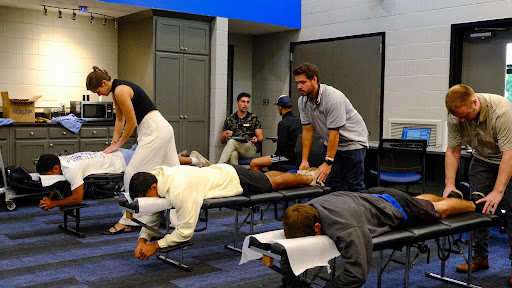
Sherman’s sports chiropractic program includes classroom education, clinical experience, and outreach opportunities. Students can study the role of chiropractic within a sports care team and later apply that knowledge while working with athletes under faculty supervision.
This progression gives students a direct connection between education and practice.
Could Sports Chiropractic Be Part of Your Future?
Many students are drawn to chiropractic because they are interested in sports, movement, exercise science, athletic training, coaching, or human performance.
Some know they want to work with athletes before they begin chiropractic college. Others discover that interest as they move through the program.
Chiropractic offers a way to remain connected to athletics while developing a distinct professional role. It allows students to work with the spine and nervous system, support recovery, and help athletes pursue higher levels of performance.
At Sherman College, students can develop that interest through focused coursework, faculty mentorship, and hands-on experience.
Why Consider Sherman for Sports Chiropractic Education?
The college you choose will shape how you understand athletic performance and how prepared you feel to work with athletes after graduation.
Sherman College gives students a clear chiropractic foundation and opportunities to study sports chiropractic in the classroom and apply it in real athletic settings. Students learn how chiropractic fits within a broader performance team while maintaining a distinct professional role.
For prospective students interested in sports, competition, and human performance, Sherman provides a path from academic study to supervised clinical experience.
Take the Next Step
Learn more about Sherman College and connect with our Admissions team.
Interested in receiving chiropractic care on campus? Learn more about becoming a patient at the Sherman College Chiropractic Center.
Frequently Asked Questions
What is sports chiropractic care?
Sports chiropractic care applies chiropractic analysis and adjusting in an athletic setting, with attention to spinal function, nervous system function, recovery, movement, and performance.
Is sports chiropractic only for injured athletes?
No. Athletes may receive chiropractic care during injury recovery, but they may also include it as part of an ongoing performance and wellness strategy.
What makes a chiropractor different from other sports care professionals?
Chiropractors are specifically trained to locate and correct vertebral subluxation through chiropractic adjustment.
Can chiropractors work with athletic trainers and physicians?
Yes. Chiropractors may work as part of a coordinated team that includes physicians, athletic trainers, physical therapists, coaches, and strength professionals.
How does the nervous system influence athletic performance?
The nervous system coordinates movement, posture, balance, reaction, and adaptation to physical stress. These functions are central to athletic performance.
Does Sherman College teach sports chiropractic care?
Yes. Sherman offers sports chiropractic coursework, clinical opportunities, and outreach experiences focused on athlete care and optimal human performance.
Do students need an athletic background to study sports chiropractic?
No. Students can develop their understanding through coursework, mentorship, and clinical experience.
Can sports chiropractic become a career focus?
Yes. Chiropractors may work with athletes as part of a general practice, a sports-focused practice, or a collaborative performance setting.